
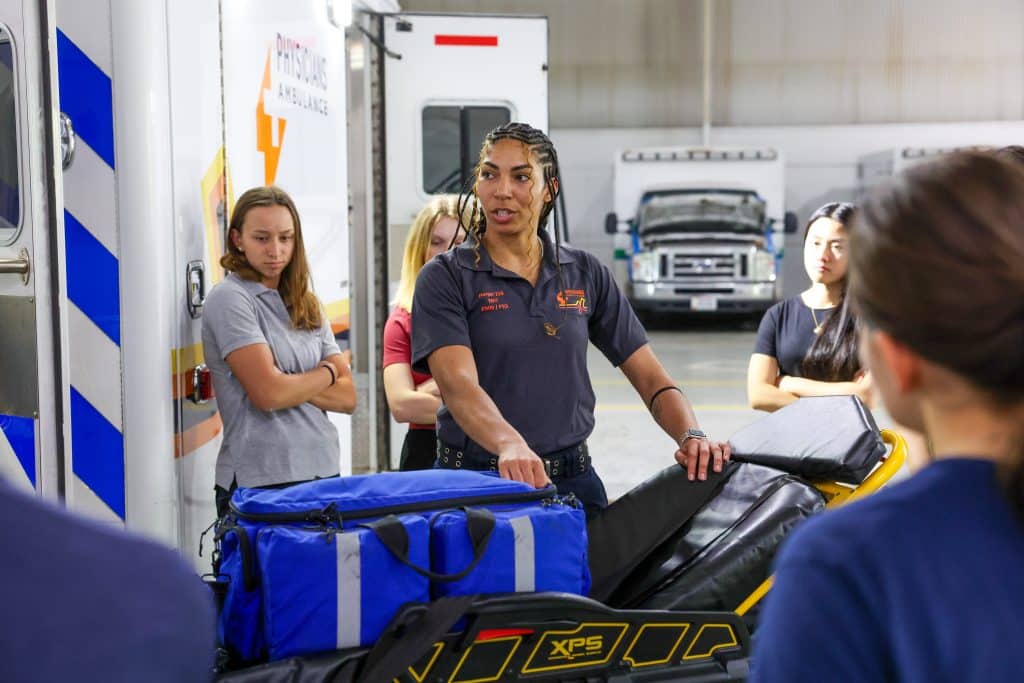
Choosing the right EMT training course is one of the most important decisions you will make when beginning a career in emergency medical services. . Not every EMS training program provides the same level of preparation, even if they promise certification. The right program prepares you to pass certification exams, build clinical confidence, and deliver safe, effective patient care from your first day in the field..
1. Verify State Approval and Program Credentials
Before enrolling in any EMS training program, confirm it is approved by your State EMS Office (or the state agency that oversees EMS education). State approval is required for EMT training and confirms the program meets your state’s education requirements and aligns with the National EMS Education Standards, which outline the knowledge and skills EMT students must learn.
For example, students pursuing EMT certification in Ohio must complete an EMT training program approved by the Ohio Department of Public Safety, Division of Emergency Medical Services, to be eligible for state certification. Completing an approved program is required before you can pursue the National Registry EMT exams and receive certification from the state.
What to check first
- You typically must complete a state-approved EMT program (and any required state skills verification) before testing for certification and becoming licensed
- Requirements vary by state, so always confirm details directly with your State EMS Office
- Many states publish public lists of approved EMT programs on their EMS agency websites
Be careful with accreditation claims
- Terms like “accredited learning center” are not standardized credentials for EMT programs
- For EMT-level education, state approval matters most
- Formal accreditation through CAAHEP/CoAEMSP applies primarily to Paramedic programs and, starting in 2025, AEMT programs
- EMT programs usually operate under state approval, not CAAHEP accreditation
How to protect yourself
- If a program claims special accreditation, ask who accredits it
- Request written documentation
- Verify the claim independently with the accrediting body or your State EMS Office
This approach ensures your training qualifies you for certification—and prevents costly enrollment mistakes.
2. Compare Program Formats and Schedule Options
EMT programs are available in different formats to fit different schedules and learning styles. Understanding how each option works helps you choose a program that fits your life while still meeting education requirements.
Training hours
Education in this field is competency-based, not just time-based. The EMT training course length typically includes 150 hours or more of combined classroom instruction, skills labs, and clinical or field experience. . Exact hour totals vary by state and program. What matters most is your ability to demonstrate required EMT competencies and apply them effectively in patient care situations.
Common EMT course formats
- Traditional classroom programs: These courses meet several days per week and combine lectures with hands-on practice. Training is usually spread over 8–16 weeks, often with evening or weekend options. In-person learning allows for direct instructor feedback and teamwork, which closely reflects real EMS work environments.
- Accelerated programs: Accelerated courses deliver the same required content in a shorter timeframe, typically 3–6 weeks. Days are long and intensive, with little downtime. These programs work best for students who can commit full-time and want to enter the workforce quickly.
- Hybrid programs: Hybrid formats combine online learning with required in-person skills labs. You complete lectures and exams online, then attend scheduled labs to practice BLS skills. These include CPR, airway management, bleeding control, splinting, and patient assessment, using standard EMT equipment. This option offers flexibility but requires strong self-discipline.
When comparing course length and structure, consider your work schedule, learning style, and outside responsibilities. A longer evening program may suit those with full-time jobs, while students with flexible schedules may prefer accelerated training.
3. Assess Instructor Credentials and Clinical Training Opportunities
The quality of your education depends on who teaches you and how much real patient experience you get.
Instructor qualifications matter
Look for an EMT basic training course taught by National Registry–certified Paramedics with active field experience. Instructors who actively respond to medical emergencies provide real-world experience that cannot be replicated through textbooks alone.
Also, ask about skills lab ratios. Smaller groups (about 8–10 students per instructor) allow for better coaching during CPR, bleeding control, airway skills, and patient assessment. Instructors from fire departments, ambulance services, and hospital-based EMS programs bring valuable perspectives.
Clinical experience varies
Clinical and field requirements differ by state and program. Some programs integrate skills competency testing directly into the course.
Instead of asking for general hour totals, ask:
- How many emergency department clinical hours are included?
- How many ambulance or field shifts will I complete?
- How many patient contacts do students typically have before graduation?
Programs partnered with high-volume EMS agencies often provide stronger hands-on clinical opportunities. Rotations may include both day and night shifts and exposure to patients ranging from stable transfers to critical emergencies.
4. Understand the Complete Financial Investment
The EMT training course cost includes more than tuition. To compare programs accurately, request a written cost breakdown from each institution. The total EMT training course cost can vary significantly depending on EMS training program, included materials, and clinical training opportunities.
Common expenses to confirm
- Tuition and lab fees
- Textbooks and digital resources
- Basic equipment (stethoscope, BP cuff, trauma shears)
- Uniforms for clinical rotations
- CPR/BLS certification (if not included)
- Background checks, drug screening, immunizations, and health documentation
- National Registry EMT cognitive exam fee: $104 per attempt
Some programs bundle many of these items into tuition. Others charge separately. A higher upfront price may cost less overall if it includes essential materials and exam fees.
Financial assistance options
Availability varies by institution. You may qualify for:
- Federal financial aid or scholarships (community colleges and universities)
- Payment plans
- Employer tuition reimbursement (fire departments, ambulance services, hospitals)
- GI Bill benefits for approved programs
When weighing cost, consider value. Programs with experienced instructors, strong clinical access, and career support often lead to better job outcomes.
5. Review Student Outcomes and Support Services
Program results tell you how well students are prepared.
What to ask for
- First-attempt certification pass rates for recent graduates
- Rates typically range between 60–70%, though stronger programs often achieve 75–80% or higher
- Verify data through your State EMS Office or the NREMT data dashboard
- Graduation and completion rates
- Low completion may signal poor support or unrealistic program demands
Strong programs also offer
- Practice exams that mirror the National Registry computer-adaptive format
- Skills review sessions before testing
- Job placement support with EMS agencies and hospitals
- Career guidance for advancement to AEMT, Paramedic, or other healthcare roles
- Continuing education and refresher access
- Instructor mentorship beyond graduation
Programs with strong local EMS partnerships often help graduates transition quickly into employment.
Strong EMS education programs treat training as the beginning of a professional relationship rather than a one-time course. .
Essential Prerequisites and Red Flags to Watch For
Before applying, confirm you meet the basic requirements. Most EMT students must be:
- At least 18 years old (some states allow 17 with parental consent or specific conditions)
- High school graduates or hold a GED
- Able to pass background checks and drug screening
- Physically capable of lifting patients and equipment (typically 50+ pounds)
- Current in CPR certification (or willing to obtain it during the course)
Watch for these warning signs when evaluating options:
- Unwillingness to share pass rates or graduation statistics
- No clear state approval documentation, or inability to provide their state approval number
- Instructors without current field experience or national registry certifications
- Vague details about clinical partnerships or rotation requirements
- Hidden fees not disclosed upfront in written materials
- High-pressure sales tactics or demands to enroll immediately without time to research
- Claims about guaranteed employment or unrealistic promises about career outcomes
Reputable institutions welcome questions and provide transparent information about their credentials, outcomes, and costs.
Launch Your EMS Career With a Proven Partner
When you’re ready to begin your journey as an emergency medical technician, choose education that reflects the professional values you’ll carry throughout your career. Physicians Ambulance Service operates a state-approved EMS training center where students receive instruction from professionals who actively serve on the front lines of emergency medical services across more than 20 Ohio counties. At Physicians Ambulance, every provider is treated as a name, not a number. We believe strong individuals strengthen the team and help deliver better care to the communities we serve.
Since 1958, Physicians Ambulance has served Ohio communities with a commitment to clinical excellence, disciplined processes, and compassionate patient care. Our approach to education mirrors our approach to patient care: we develop professionals of character who demonstrate integrity, teamwork, and dedication to serving others. While clinical skills are taught through structured coursework and hands-on training, ,we seek students who already possess the heart of a caregiver and the commitment of a true first responder. Our instructors bring real-world knowledge from responding to both critical emergent patients and routine medical transports, ensuring you learn the full scope of pre-hospital care from professionals who practice it every day.
Ready to explore your options? Learn about upcoming course offerings at Physicians Ambulance’s Clinical Education Center. Call 888-519-1130 or visit our Clinical Education page to discover how we prepare passionate individuals for successful careers in emergency medical services. https://physiciansambulance.com/clinical-education/