
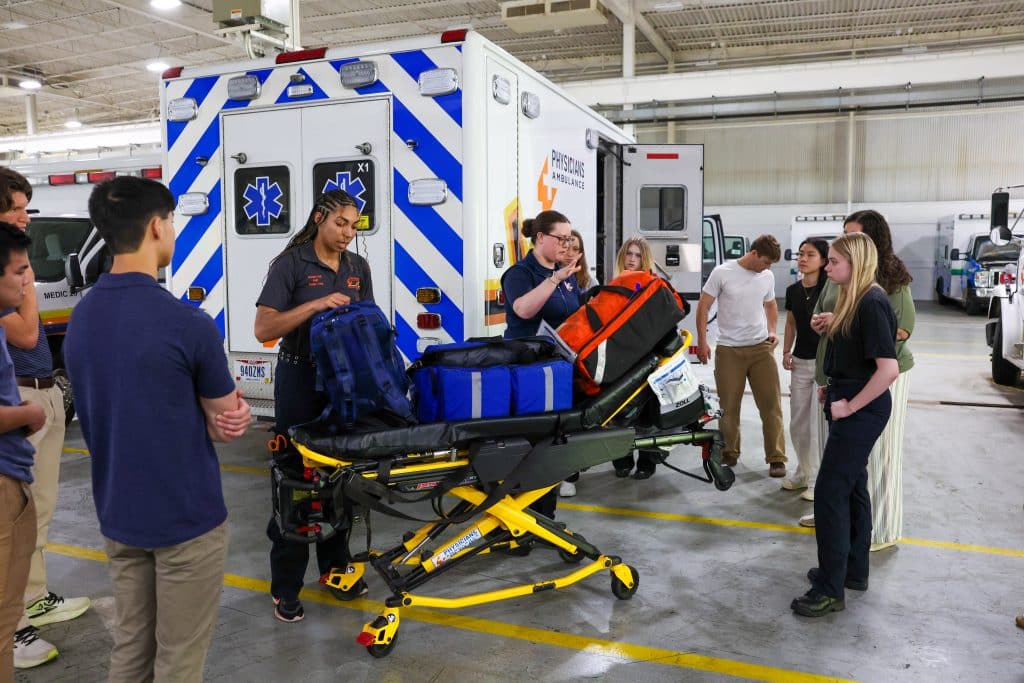
If you’ve ever wanted to be the person who shows up when things go wrong, the one who can remain calm under pressure and knows exactly what to do to save lives, becoming a paramedic might be the right path for you. But figuring out where to start can feel overwhelming. Licenses, exams, accreditation standards, there’s a lot to sort through.
This guide breaks it all down clearly, specifically for Ohio. You’ll learn how to get paramedic certification in Ohio, what to expect at each stage, and how to move into your first role once you’re licensed and ready to work.
Table of Contents
What Does a Paramedic Actually Do?
According to the National Registry of Emergency Medical Technicians (NREMT), a paramedic is an allied health professional who provides advanced emergency medical care to critically ill patients in the field. They are a key link in the EMS system, connecting emergency scenes to the broader healthcare system. They work under medical oversight while making fast, independent decisions in the field.
Paramedics deliver extensive pre-hospital care that goes well beyond what other emergency medical responders are trained to do. Where an EMT handles basic life support: CPR, wound care, oxygen, a paramedic performs interventions that require a much deeper level of medical training.
This includes the ability to:
- Administer medications both orally and intravenously
- Interpret cardiac rhythms
- Perform advanced airway management techniques such as endotracheal intubation
- Insert IV lines to stabilize patients before and during transport
In Ohio, the scope of paramedic practice sits at the top of the state’s EMS certification ladder. The Ohio Division of Emergency Medical Services, within the Ohio Department of Public Safety, oversees four certification levels:
- Emergency Medical Responder (EMR)
- EMT
- Advanced Emergency Medical Technician (AEMT)
- Paramedic
In Ohio, the scope of paramedic practice sits at the top of the state’s EMS certification ladder. The Ohio Division of Emergency Medical Services, within the Ohio Department of Public Safety, oversees four certification levels:
- Emergency Medical Responder (EMR)
- EMT
- Advanced Emergency Medical Technician (AEMT)
- Paramedic
Each with progressively more training and authorized skills under Ohio Administrative Code Chapter 4765. Paramedics carry the most comprehensive clinical scope of any prehospital provider on the ground.
Ohio paramedics work in private ambulance services, fire departments, hospital emergency departments, air medical transport, critical care transport teams, and community paramedicine programs.
How to Get Paramedic Certification in Ohio: Step-by-Step
Step 1: Earn Your High School Diploma or GED
Every accredited paramedic program in Ohio requires a high school diploma or its equivalent as a baseline entry requirement. Without one, you cannot enroll in EMT training. The required first step on the path to paramedic certification.
Step 2: Complete an Ohio-Approved EMT Program and Get Certified
Ohio paramedic programs require current EMT-level certification (or higher) before you can enroll. That means your first goal is to become a certified EMT in Ohio.
EMT programs in Ohio typically run 150–200 hours and take four to six months to complete, depending on whether you attend full-time or part-time. The curriculum covers:
- CPR
- Basic life support
- Trauma response
- Emergency protocols
These are the entry-level foundations every emergency medical technician needs before advancing. Ohio programs must meet the 2009 National EMS Education Standards and are taught by state-certificated EMS instructors, in accordance with Ohio Administrative Code 4765-18.
After completing a state-approved EMT program, you’ll pass the National Registry EMT certification exam and complete your State EMS Office’s BLS skills competency requirement. This is administered separately at the state level, and then you apply for your Ohio certificate to practice through the Ohio Division of EMS. In Ohio, this state certificate authorizes you to work as an EMT alongside your national certification.
Ohio also recognizes the Advanced Emergency Medical Technician (AEMT) as an intermediate step between EMT and paramedic. While not required for paramedic enrollment, AEMT certification expands your clinical skills and can strengthen your paramedic school application.
Step 3: Build Field Experience as an Ohio EMT
Most Ohio paramedic programs require or strongly prefer applicants with at least 6 months of real field experience as EMTs. Paramedic school is academically and practically demanding, and hands-on EMS work builds the foundation you’ll need to keep up.
Working in the field:
- Sharpens patient assessment skills
- Builds familiarity with EMS environments across the range of calls Ohio generates: urban trauma, rural cardiac events, interfacility transport
- Gives you a clearer sense of what advanced training actually involves
Programs consistently report that students with prior field exposure perform better and complete at higher rates than those who enter directly after EMT certification. Be prepared to document your experience through employment records or a supervisor’s verification; Ohio paramedic programs will ask for this.
Step 4: Enroll in a CAAHEP-Accredited Ohio Paramedic Program
To qualify for National Registry paramedic certification and Ohio licensure, you must graduate from a CAAHEP-accredited paramedic program. Programs with a CoAEMSP Letter of Review (actively working toward accreditation) are also eligible.
Ohio law requires new paramedic programs to hold CAAHEP accreditation or a Letter of Review before enrolling students. There are more than 20 accredited programs across the state, offered through community colleges, technical schools, and universities. You can search for approved programs on the CAAHEP website.
Ohio paramedic programs follow the National EMS Scope of Practice Model and state curriculum rules, which include required subject areas and minimum clinical experience, such as documented patient assessments.
Typical coursework includes:
- Advanced airway management
- Cardiology and pharmacology
- Patient assessment and trauma care (including Ohio trauma triage protocols)
- Pediatric and obstetric emergencies
- EMS operations and medical oversight
Programs combine:
- Classroom instruction
- Skills labs
- Clinical rotations (ED, cardiac units, labor & delivery, etc.)
- Field internship
Most programs take 1–2 years, depending on whether you enroll full-time or part-time. Clinical rotations are where students apply classroom learning to real patient care under supervision. Authorized skills and medications are in accordance with the Ohio EMS scope of practice and local medical direction.
Before enrolling, confirm two key requirements:
- Your program verifies completion of the CoAEMSP Student Minimum Competency (SMC) Matrix (required for NREMT eligibility).
- You must apply for the NREMT paramedic exam within two years of program completion.
Step 5: Pass the NREMT Paramedic Certification Exam
Once your program director verifies your completion on the NREMT website, you’ll receive an Authorization to Test (ATT) and can schedule your exam at a Pearson VUE testing center. Ohio uses the National Registry examination process for paramedic certification. Here’s what the exam involves:
- Format: Computer Adaptive Test (CAT)
- Questions: 110–150
- Time limit: 3 hours, 30 minutes
- Exam fee: $175 per attempt
The exam covers six domains:
- Airway and ventilation
- Cardiology and resuscitation
- Trauma
- Medical and OB-GYN emergencies
- EMS operations
- Clinical judgment
The computer adaptive format is designed to determine whether you have reached entry-level competency. It adjusts in difficulty based on your responses and ends when the system can make that determination with confidence.
Most candidates pass within their first few attempts, but a meaningful percentage need more than one try. The NREMT permits up to six total exam attempts within two years of program completion. Candidates who fail three times must complete remedial education before their fourth attempt. If all six attempts are exhausted without passing, re-entry into a paramedic education program is required.
Step 6: Apply for Your Ohio Certificate to Practice
Passing the NREMT exam earns you national paramedic certification, but in Ohio, you also need a separate Ohio certificate to practice, issued by the Ohio Division of Emergency Medical Services. This is an important Ohio-specific distinction: national certification and state certification are two separate credentials. Your Ohio certificate legally authorizes you to practice as a paramedic in the state.
Under Ohio Administrative Code 4765-8-01, Ohio applicants for a certificate to practice must:
- Submit a completed application approved by the Ohio EMFTS Board
- Successfully complete an approved paramedic training program
- Pass the National Registry paramedic certification examination
- Pass a criminal background check
- Meet character and fitness requirements set by the board
Ohio paramedic certificates expire on the holder’s birthday in the third year, giving most providers a three-year certification cycle. A quick note on reciprocity: if you’re already certified in another state, Ohio does have a reciprocity process. Contact the Ohio Division of EMS to confirm current reciprocity requirements and application forms.
What Are the Ongoing Requirements After Ohio Paramedic Certification?
Getting certified is the milestone, but maintaining it is part of the job. Ohio operates on a three-year certification cycle. The renewal requirements are set by the Ohio Division of EMS under OAC 4765-17-02, not by the NREMT’s NCCP model. Ohio does not follow the National Registry’s NCCP recertification structure.
For a full three-year (36-month) certification cycle, Ohio paramedics must complete 75 hours of continuing education, structured as follows:
- 12 hours — Pediatrics
- 4 hours — Geriatrics
- 6 hours — Cardiac emergencies (satisfiable by completing AHA or ASHI ACLS)
- 8 hours — Trauma, including the Ohio Trauma Triage course
- 1 hour — Ohio Dementia Awareness training (required at each renewal cycle)
- Remaining hours — Flexible EMS-related CE
CE hours are prorated if your certificate was active for fewer than 36 months. Ohio accepts all CAPCE-accredited courses and CE promulgated by an Ohio-accredited or approved institution. Ohio does not maintain a separate list of approved CE providers beyond those already CAPCE-accredited or state-accredited. It also does not use a third-party system to track your CE hours. You are responsible for maintaining your own records. Given that 10% of providers are randomly audited each month, the Division of EMS recommends retaining all CE certificates for at least 2 full certification cycles (6 years).
Alternatively, Ohio allows renewal by examination: pass the NREMT cognitive exam within the last six months of your certification cycle, with a maximum of 3 attempts.
If you also hold national NREMT certification (which Ohio strongly encourages), you’ll need to maintain it separately under the NREMT’s NCCP. It requires 60 CE credits every two-year cycle and accepts State EMS Office–approved education, CAPCE-accredited education, and other approved sources.
Specialty certifications strengthen your skills and open doors to advanced roles:
- ACLS — Advanced Cardiac Life Support (also satisfies Ohio’s 6-hour cardiac CE requirement)
- PALS — Pediatric Advanced Life Support
- PHTLS — Prehospital Trauma Life Support
- NREMT notification — If you hold national certification, you are required to notify the NREMT within 30 days of any disciplinary action against your state certificate or any change to your mailing address.
How Long Does It Take to Get Paramedic Certified in Ohio?
For anyone mapping out how to get paramedic certification in Ohio from the ground up, with no prior EMS experience, here is what the full path looks like:
|
Stage |
Estimated Time |
|
EMT training and Ohio certification |
4–6 months |
|
EMT field experience |
6–12 months (varies by program) |
|
Ohio paramedic program |
12–24 months |
|
NREMT exam and an Ohio certificate to practice |
1–2 months |
|
Total |
2–3.5 years |
Going straight from EMT certification into paramedic school without field experience can bring the total to around two years. Adding field time before applying puts it closer to three to three and a half years. As noted in Step 3, that time in the field consistently pays off in program performance and career readiness.
How Do You Prepare for the NREMT Paramedic Exam?
A clear strategy makes all the difference. The exam is rigorous, and candidates who treat it as an afterthought to their program rarely perform as well as those who prepare consistently throughout:
- Study throughout your program, not just before the exam. The material spans six domains and a wide range of clinical scenarios. A concentrated last-minute review is rarely enough.
- Use NREMT-style practice questions. The CAT format adjusts to your performance level. Being familiar with how questions are framed helps you work more efficiently on test day.
- Target your weakest domains first. After practice exams, identify which of the six domains needs the most work and weight your study time accordingly.
- Know Ohio’s skills competency process. The NREMT paramedic exam is now a single cognitive assessment. The separate psychomotor exam was discontinued in July 2024. Ohio may have state-level skills verification requirements as part of the certificate-to-practice process; confirm the current requirements with the Ohio Division of EMS before you apply.
- Read the NREMT candidate handbook. It outlines which domains are tested and in what proportion. Use it to structure your study plan from the beginning.
Understanding the landscape is useful, but getting certified starts with passing this exam. Prepare for it like it matters, because it does.
Start Your Career Where the Standard Is Higher
You’ve put in the work to get certified. Where you take that certification next matters. Physicians Ambulance has been building careers in emergency medical services since 1958. Three generations of the Hess family leading an organization that’s grown to serve over 20 Ohio counties with partnerships across more than 250 healthcare entities.
Our Accredited Learning Center is staffed by five certified EMS instructors and runs under the medical direction of Dr. Donald K. Spaner, President of the University Hospitals Health System EMS Institute. Physicians is the only private ambulance service in Ohio to independently operate a Paramedic III program, an advanced pathway that opens doors to critical care, stroke team, and flight paramedic roles.
Whether you’re newly certified or ready to advance, Physicians Ambulance hires on character first: the ethics, the judgment, the commitment to the people you serve. The clinical skills can be taught. The kind of person you are is what gets you through the door.